Friday, May 20, 2016

Volunteer Staff Updates!


Almost two years ago, we announced with a sad heart that one of our founding partners, Kim Rooks, had resigned her position with Broken Hearts of Florida.

It is with a happy heart that today we announce Kim's return to the Broken Hearts fold as assistant executive director! 

We are also tickled to announce that our phenomenal Gainesville chapter leader, Candice Pridemore, is now assistant executive director.

With the combined leadership of Kim, Candice and BHF Executive Director Karen Thurston, Broken Hearts will continue to thrive and grow. We are excited about our future!

Please join in me welcoming back Kim and in congratulating these two compassionate and talented women on their new positions!

Friday, November 7, 2014

Memorial Donations for Maryjane Blizzard Thurston

Maryjane Blizzard Thurston
Sept. 6, 1927 - Nov. 2, 2014
On Nov. 2, 2014, our founder's mother died after a long illness. Karen Thurston Chavez's mother was an avid, longtime supporter and contributor to Broken Hearts of Florida.

Karen's mother, Maryjane Blizzard Thurston, requested that donations be made in her memory to her daughter's organizations. Maryjane's obituary ran Nov. 5, 2014: Maryjane Blizzard Thurston Obituary.

Broken Hearts was near-and-dear to Maryjane's heart because her youngest grandson, William -- Karen's younger son -- was born with a congenital heart defect. A few months after his diagnosis in spring of 2005, Maryjane's daughter, Karen Thurston Chavez, founded BHF as a way to connect and help families affected by CHD. Throughout the years, Maryjane regularly and faithfully attended a variety of Broken Hearts of Florida events, including its regional forums and monthly family dinners.

We've established a giving page through JustGive.org to accept donations in Maryjane's memory.

Please visit Maryjane Thurston Memorial Donations to make your memorial contribution to Broken Hearts of Florida, a nonprofit organization that supports, educates and connects families affected by congenital heart disease.

Thank you for your thoughtfulness.

Friday, October 24, 2014

Volunteer Staff Changes


Dear Broken Hearts of Florida Families:

It is with a heavy heart that we announce Kim Rooks’ resignation from Broken Hearts of Florida. Kim's resignation letter is included below. 

Rest assured, Broken Hearts of Florida will continue to do what it does best – support, educate and connect families affected by congenital heart defects and other pediatric heart diseases.

Sincerely,

Your BHF Board of Directors/Advisory Board Members


Board of Directors

  • Tammie H.
    Eldred
  • Fran Gilbert
  • Suzanne Owen
  • Samantha H. Padgett

Advisory Board

  • Alyssa Brown
  • Rachel Lawley
  • Connie Nixon, RN

Chapter Leaders/Key Volunteers

  • Candice Pridemore
  • Jessica Demino-Maier
  • Samantha Roberts

 Volunteer Staff

  • Karen Thurston Chavez
    Founder/Executive Director of Operations and Outreach


Friday, October 10, 2014

Radio Montage Still Makes Me Cry

One of our heart families is recording their story today for an upcoming radiothon for Children's Miracle Network. It made me think of the montage I recorded for a long-ago radiothon in Tallahassee. Even after six years, William's montage still brings me to tears.

William's Story: Listen here.

Now if you'll excuse me, I need to go find some tissues.

Karen


Saturday, November 16, 2013

Does God give us more than we can handle? Read this and you decide.

This week has been a very hard week for several of our heart families, for my colleagues at work, for some local families in Tallahassee I've never met but have been praying for, for fellow heart moms I've never met in real life but love keeping up with through Facebook. 

Over the past several weeks, I've seen posts that say or allude to the saying that "God doesn't give us more than we can handle." And each time I see it, I think about this blog post by Jill Haskins, a fellow heart mom I've never met in real life, but love chatting and Facebooking with. 

Jill says that God does give us more than we can handle, and she explains why she believes that. Jill gave me the OK to share her blog post here ... thank you, Jill, for always sharing your heart, even when it's breaking. 

God DOES give us more than we can handle.


Monday, November 11, 2013

High Fives to Our Heart Heroes!


 We Are ... Broken Hearts of Florida
Living with congenital heart defects or other pediatric heart disease (or any chronic or acute illness, really) creates a persistent, underlying stress in our daily lives, and it can be easy sometimes to fall into a habit of focusing on that stress and worry. 

So when I come across a feel-good song about celebrating victories, about living in the moment, about not wasting a single minute of the time we're given, I often feel compelled to let one of my favorite hobbies take over of my time. No, really. I get obsessed until the project is done! When I find just the right song and just the right images and put them together in just the right sequence to create a message that just makes you feel good ... well, I can't help myself.

My 9-year-old is a big fan of Big Time Rush, and when I heard the song, "We Are," on the TV  a few weeks ago, while William was watching the video, I listened closely to the lyrics, and I knew immediately it was one of those just-right songs to celebrate our heart kids and adults. 

I dare you to watch this and not, at some point, raise your hands in the air, or at least give these Heart Heroes thumbs up salute. 


We Are ... Broken Hearts of Florida. 

Sunday, October 13, 2013

Every Bit Helps

We are helping hands in a family's journey with pediatric heart disease. Every bit helps. To make a donation and help a family in crisis,
GO HERE.
Broken Hearts of Florida awarded its first Home-Away-From-Home assistance to a family of five.

It felt good this weekend to hand over the card of encouragement and empathy, and the $600 worth of MasterCard gift credit/debit cards and gas card that were tucked inside it.

I told the new heart mom that I wished Broken Hearts of Florida could have covered all their expenses while their baby underwent open-heart surgery at UF Health Shands Children Hospital in Gainesville.

But the North Florida mom smiled; she was grateful. “Every bit helps,” she said. “This helps so much.”

Seven years ago, when Broken Hearts of Florida was founded, this kind of assistance would not have been possible. When families needed financial help, we did a shout-out – via email! – on a case-by-case basis to our other families, asking them to make a personal contribution. We were always thankful for every penny we could collect, as were the families who received maybe $50 of the $500 they needed to keep the lights on and the rent or mortgage paid.

We are humbled and thankful to provide these things to heart families who need us. We are grateful to all of the Broken Hearts contributors and sponsors, who make these gifts possible.
Please help us so that we may continue to support, educate and connect heart families in need. As that heart mom said, “Every bit helps.”
Our organization is completely volunteer-driven. All of our revenue goes straight back to helping our families get through life-changing surgeries, medical crises, and the joys and triumphs.

All of our donation information is available here. Let’s keep supporting, educating and connecting heart families.

We’ve come such a long way since then! Over the past year alone, Broken Hearts of Florida has joyfully provided:
  •         almost $2,000 in financial assistance to almost a dozen heart families
  •         on average, two to three dinners a month for families staying on the 10th and 4th floors of UF Health Shands Children’s Hospital;
  •         more than $300 worth of toiletries for families who have found themselves at UF Health quite unexpectedly;
  •         snacks and light meals through its Food from the Heart Pantry for families staying on the 10th floor at UF Health Shands
  •         almost a dozen monthly Family & Friends Dinner Nights;
  •         a full-fledged, tons-of-fun May Day Picnic for families and medical caregivers; and
  •         given out nearly 150 care packages to families in the hospital.
Your donations make it possible. Thank you from the bottom of our hearts.

Monday, July 22, 2013

Thank you to our Hearts in July sponsors and in-kind donors!

We're grateful for sponsors and in-kind donors who have helped make Hearts in July possible. Because of their generous support, Broken Hearts of Florida will be able to help families in need through its new Home-Away-From-Home Program, designed to help families stay together when they're children are hospitalized.


Broken Hearts of Florida’s Home-Away-From-Home Program is designed to help Big Bend-area families stay with their kids while they’re hospitalized in Gainesville for heart-related reasons. 

Home-Away-From-Home will provide lodging assistance to families in need, freeing them to focus on what is important -- helping their children get better. Free and low-cost housing and lodging options are available in Gainesville, and they work well for families who need to stay in Gainesville longer than 12 or 15 days. But for stays ranging from 2 to 10 days, these options often don’t work out, leaving families to find other, often more expensive accommodations. Many families simply cannot afford this expense, and find themselves sleeping in the hospital’s lobbies or in their cars. Parents of children in the hospital are under enough stress without the compounded strain of wondering where they will stay while away from home.


Money raised at our first, evening fundraiser -- Hearts in July -- will help us launch the program. Go here for more information about Hearts in July.

Thursday, June 27, 2013

Join us for Hearts in July!

Watch our commercial.
Join Broken Hearts of Florida for Hearts in July -- a fun-filled fundraising event for the whole family! The evening includes dinner, a silent auction, supervised kids’ activities, and music and dancing. We’ll also have some special guests!

The public is welcome! Meet some amazing families and heart heroes, learn more about what Broken Hearts of Florida is doing in your community, and have a great time! 

Tickets are $12 per person. All proceeds go toward launching Broken Hearts of Florida’s new “Home-Away-From-Home Program,” helping families stay with their children while they’re hospitalized for heart-related reasons. 

The event will be held Friday, July 26, 2013, from 6 to 10 p.m. at Sittig Hall in Kleman Plaza at 301 S. Bronough St., Tallahassee, FL.

We are also looking for event sponsors and items for our silent auction. 

About Us and Our Home-Away-From-Home Program

Over the past year, we’ve been providing financial assistance to Big Bend-area heart families in need when they’ve had to travel to Gainesville for routine appointments, open-heart surgeries, or other congenital-heart-related procedures at UF Health Shands Hospital for Children and the UF Health Congenital Heart Center, the only medical facility in our region that provides this highly specialized care. The families’ biggest needs have been with overnight and extended-stay accommodations.

Our new Home-Away-From-Home Program will provide lodging assistance to Big Bend-area families in need. While there are free or low-cost lodging options available in Gainesville, such as the Ronald McDonald House, they are often at capacity, leaving families to find other, often more expensive accommodations. 

For many families, this is an expense they simply can’t afford, and so they find themselves sleeping in the hospital’s lobbies or in their cars. These parents are under enough stress without the compounded strain of wondering where they will stay while they’re away from home.

Founded in 2006, BHF is a nonprofit, charitable organization that supports, educates and connects families affected by congenital heart defects and other pediatric heart diseases. We have chapters based in Tallahassee, Gainesville and Panama City that serve those cities and surrounding counties. 

We started as a small group of three families and today, we are 250 families strong. Our services have expanded with our growth and are designed to help families navigate the lifelong journey of living with congenital heart defects and pediatric heart disease. 

Thursday, June 20, 2013

Meet & Greet Lunch with Nels Matson

Meet Nels Matson!

Join us for lunch with Nels Matson, who is running 1,200 miles in 35 days from Bradenton, FL, to the Royal Embassy of Cambodia in Washington, D.C. 

Broken Hearts of Florida will host lunch for Nels and Diplo on Sunday, June 23, from 1 to 3 p.m. at Chili's at 3530 S.W. Archer Road, Gainesville. RSVP for lunch through our Facebook event page, or email us at info@brokenheartsflorida.org and let us know you are attending the lunch and how many will be with you. 

If you or your child has a congenital heart defect, come out and sign Diplo, the Diplomatic Penguin, who is riding on Nels’ back. You’ll also have a chance to meet Nels’ Gainesville Heart Diplomat, Sage Pridemore, a local CHD survivor.
Nels, Denise and Diplo at Broken Hearts' May Day Picnic. 

There are about 100,000 children in Cambodia who have congenital heart disease; very few are treated. Nels is running to fund heart surgeries for these children through Hearts Without Boundaries. Nels was saved by an open-heart surgery when he was a toddler, and wants to give these children the same opportunity at life he was given!

Nels’ journey began June 15 in Bradenton. Diplo the penguin will be given as a gift and symbol of support to the children receiving the heart surgeries in Cambodia.

For more information about Tri4Number1 Run, visit http://www.t41run.com/.

Wednesday, May 22, 2013

Oil Change Fundraiser for Broken Hearts of Florida


Join us Monday, May 27, at Super Lube at
6541 Thomasville Road (near Bradfordville Road)
between 8 a.m. and 4 p.m. for our
 
Oil Change Fundraiser!

You get 50% off your oil change, plus free lunch! While Super Lube changes your oil, you can enjoy a hot dog or and hamburger, a bag of chips and ice cold drink! And, a portion of the proceeds go to Broken Hearts of Florida to help families affected by congenital heart disease and other pediatric heart diseases.

Listen to our radio ad.


Our programs and services include:
  • a Financial Assistance Program for heart families who need assistance during a planned or unexpected hospital stay;
  • PICU Family Dinners, a weekly event held in the Pediatric Intensive Care Unit and UF Health Shands Children’s Hospital where families in the Unit enjoy a free meal and good company;
  • Food from the Heart Pantry, a source of free, quick, nutritious snacks and light meals for families in the Pediatric Intensive Care Unit and UF Health Shands Children’s Hospital;
  • Care Packages for children and families who are in the hospital; and ouR
  • May Day Picnic, an annual daylong event in Gainesville for heart families and their health-care providers.
Come get your oil change for half-price, get a free lunch and support an organization that supports, educates and connects families affected by pediatric heart disease. 

We sincerely thank Super-Lube and Cumulus Radio
for their generous support of Broken Hearts of Florida! 


For more information, contact us at info@brokenheartsflorida.org.


Monday, October 1, 2012

Broken Hearts of Florida Achieves Public Charity Status with Internal Revenue Service

After six years of operating as simply a nonprofit corporation in the state of Florida, Broken Hearts of Florida Inc. applied earlier this year for tax-exempt recognition from the Internal Revenue Service. It was an important step for if the organization wanted to move forward, grow and provide more programs, services and resources for its heart families. 

GOAL ACHIEVED! 

Broken Hearts of Florida Inc. -- which supports, educates and connects families affected by congenital heart disease and other pediatric heart diseases -- received its Letter of Determination today from the Internal Revenue Service, declaring BHF tax-exempt under section 501(c)(3) of the Internal Revenue Code. All contributions to BHF are tax-deductible under section 170 of the Code. Further, BHF is considered a Public Charity by the IRS. 

Broken Hearts of Florida was founded in 2006 as a local support group, Broken Hearts of the Big Bend. It was established as a nonprofit corporation with the Division of Corporations with the State of Florida in 2007. 

"Our families are the core of our organization," said Karen Thurston Chavez, BHF Founder and BHF's executive director of operations and outreach. "We're looking forward to a fantastic 2013!"

In late 2010, Broken Hearts of the Big Bend changed its name to Broken Hearts of Florida to reflect its growth. Broken Hearts has grown from just a handful of Big Bend Region families to more than 200 families from all across Florida, with concentrated membership throughout the Panhandle and North Central regions of the Sunshine State. We have three chapters -- Big Bend Region (Tallahassee and surrounding counties), Emerald Coast (Panama City and surrounding areas) and Central Florida (greater Gainesville and Ocala areas). 

In the beginning, our services in the beginning consisted simply of occasional meetings and moral support. Today, Broken Hearts of Florida provides:
  • a Financial Assistance Program to heart families in need; 
  • the Food from the Heart Pantry at the UF Health Shands Children's Hospital Pediatric Cardiac Intensive Care Unit; 
  • care bags for children and families in the hospital; 
  • a weekly meal for families in the UF Health Shands Pediatric Cardiac Intensive Care Unit; and
  • regular dinner meetings.
For more information about Broken Hearts of Florida and to find out if there are Broken Hearts families in your area, contact us:


Thursday, February 9, 2012

CHD Awareness Week Proclaimed in Florida


It's Congenital Heart Defect Awareness Week. Each year from Feb. 7-14, the congenital heart community pushes extra hard to raise awareness of congenital heart defects. All over Florida, our heart moms and heart dads, heart kids and heart grown-ups, tell their stories of diagnosis, surgery and treatment, and of courage and strength. We've created a fact sheet for you, if you want more information about congenital heart defects.

So many people will stay to us, "I don't know how you've managed; I don't know if I could do it." And our answer often is, "You manage. You find a way. You have to." 

To all of our heart heroes and our heart angels, to all of our heart parents, siblings, grandparents, aunts, uncles, cousins, friends and admirers ... to all of our physicians, our nurses, our social workers, our therapists, our caregivers ... 

WE LOVE YOU WITH ALL OUR HEARTS!

Florida Gov. Rick Scott officially proclaimed Feb. 7-14 as
Congenital Heart Defect Awareness Week.

Wednesday, February 8, 2012

Pulse Oximetry: Newborn Screening for Congenital Heart Disease

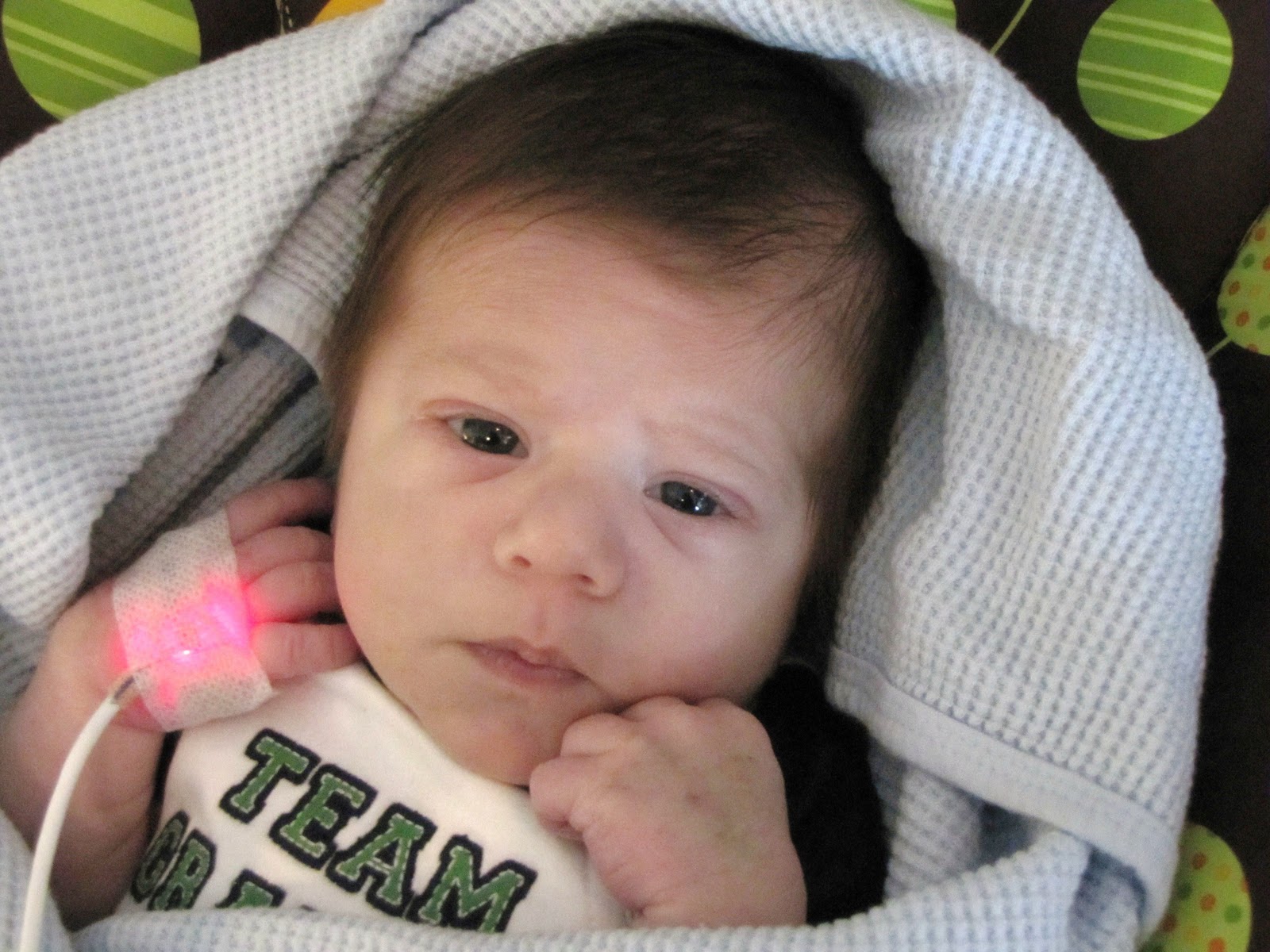
Pulse oximetry helps detect congenital heart defects
when performed at some point after 24 hours of life.
It is painless, noninvasive and practical.
The Florida Legislature has been considering Senate and House bills that would require hospitals throughout the state to add critical congenital heart disease (CCHD) to the panel of 35 newborn screening tests that Florida hospitals already do after a child is born.

The test they would add is called pulse oximetry and it is an inexpensive, painless, noninvasive way to increase the likelihood of hospital staff to detect CCHDs in newborns.

Early diagnosis and treatment of congenital heart defects greatly improves a baby's chances of leading a healthy, typical life. Delayed diagnosis can lead to death or injury to babies. According to the American Academy of Pediatrics, numerous studies show that adding pulse oximetry to the newborn assessment can enhance CCHD detection of CCHD. 

As children, parents and loved ones affected by CHD, we all understand on a first-hand basis the effects of CHD. This legislation presents us with an opportunity to help educate our elected officials on the prevalence of CHD and on pulse oximetry as an inexpensive, painless, noninvasive way to increase the chances of physicians detecting CHDs in newborns. Most importantly, we can ask them to vote yes to help increase positive outcomes for affected newborns and their families. 

If you would like to contact your Florida legislator and tell him/her to support SB 1052 and HB 829, here's how you can do it.  

Please take a moment to copy, paste and personalize the letters below and send them via email to your senator and representative. The highlighted sections are the areas that will require you to either fill in additional information or personalize.

If you do not know who your legislators are, you can find out by clicking this link and entering your address

Sample Letter to Senator   

The Honorable [Senator name]
Florida Senate
Address

Dear Senator[name]:

My name is [name] and I live in [city] in your district. I’m asking you today to vote yes on Senate Bill 1052, Newborn Screening for Congenital Heart Defects, which would require pulse oximetry screening for every newborn. This inexpensive screening will save lives and improve the outcomes for hundreds of babies born with broken hearts.

[Insert your story here. Try to keep it to five or fewer sentences. If pulse oximetry helped to diagnose your child, say that]

Pulse oximetry helps detect congenital heart defects when performed at some point after 24 hours of life. It is painless, noninvasive and practical. Hospitals already have the equipment, and, in most cases, it takes less time to perform the screening than it does to change a diaper. Similar bills have been passed in Maryland, New Jersey and Indiana, and many other states are considering pulse oximetry screening laws.

Thank you, [Senator name], for taking the time to read this letter. I look forward to hearing the results of the vote. Again, please vote yes on Senate Bill 1052.

Sincerely,

[Your name]


Sample Letter to Representative

The Honorable [Representative name]
Florida House of Representatives
Address

Dear Representative [name]:

My name is [name] and I live in [city] in your district. I’m asking you today to vote yes on House Bill 829, Newborn Screening for Congenital Heart Defects, which would require pulse oximetry screening for every newborn. This inexpensive screening will save lives and improve the outcomes for hundreds of babies born with broken hearts.

[Insert your story here. Try to keep it to five or fewer sentences. If pulse oximetry helped to diagnose your child, say that]

Pulse oximetry helps detect congenital heart defects when performed at some point after 24 hours of life. It is painless, noninvasive and practical. Hospitals already have the equipment, and, in most cases, it takes less time to perform the screening than it does to change a diaper. Similar bills have been passed in Maryland, New Jersey and Indiana, and many other states are considering pulse oximetry screening laws.

Thank you, Representative [name], for taking the time to read this letter. I look forward to hearing the results of the vote. Again, please vote yes on House Bill 829.

Sincerely,

[Your name]


Tuesday, November 22, 2011

Loving Caleb


Kim and Caleb, October 2011
By Kim Harris

Hello, worry; welcome back. This is exactly how I felt when I got pregnant. I was always a worrier and for me, pregnancy was no different. I would call my mom throughout the day, crying. I was worried. What’s new?

What I worried about was so trivial at the time, but I didn’t know it. To me, they were legitimate fears: Would I love my child enough? Would I know what to do with a boy? What if I didn’t bond with my child the way a mom is supposed to? What if I became angry at him when he took my sleep? What if I couldn’t handle motherhood the way I thought I could?”

Never once did I ask, “What If he’s not healthy?” I assumed he was. Every appointment showed a good, strong heartbeat. I was in my 20s and in good health. That means I’m guaranteed a healthy baby, right? I soon found out how very wrong I was.

Kim with Caleb, shortly after his birth.
On Dec. 22, 2009, my life was forever changed. Caleb joined this world at 10:06 in the morning. Instantly, I was in love. I immediately felt my world change. I knew in that second he was given to me, that I had a gift, a responsibility, and I would die for my child.

I was overwhelmed with emotion. I remember my parents being there, and a great friend had visited. I let everyone hold Caleb as much as they wanted, and I just kind of laid back and took in the fact that I was now a mom. I figured I would let everyone enjoy him now, and I would get him all to myself in two short days when we were discharged and at home. Sometimes, I regret that. I wish I would have held him more, and snuggled up with him more, but I had no clue and had no way of knowing what was to come.

I decided early I wanted him in the room with me all night. My heart was so full of love and I just wanted to fall asleep knowing my baby was next to me, safe in my room. I didn’t want him in the nursery. Around 10 or 11 p.m., I had Caleb in the bed with me and I was studying every part of him. He looked just like his dad. He was so peaceful. He was a little purple, but I figured every newborn looked like that. He was perfect and my life felt complete.

I had been awake for 36 hours and it was finally taking its toll. I realized I couldn’t have him in the room with me. As much as I tried to fight it, I had to call the nursery to come get him. They were my saving grace in more ways than one.

I finally drifted off to sleep, and around 2 a.m., a nurse woke me up, telling me there was something wrong with Caleb’s heart, but they weren’t sure what. A lot of things were thrown at me and I can’t remember it all, mostly because of lack of sleep, pain relievers and pain. I remember my husband telling me it wasn’t that big of a deal. That worry crept back into my head; I said, “It has to be bad if they’re rushing him to another hospital.”

About an hour later, we were allowed to see him before he was rushed to Shands Children’s Hospital in Gainesville, a hospital that at that point, I had never even heard of.  Caleb was in an incubator and now he looked like something was wrong with him. I don’t know if the wool had finally been taken off my eyes but right then and there, I knew something was wrong and he no longer was my “perfect” baby.

They discharged me a day early to be with Caleb the next day. We went home, got changed, and off we went to this hospital we knew nothing about. We went to the Shands’ neonatal intensive care unit and saw Caleb. It was terrifying. He was on a ventilator and had monitors everywhere. The beeps were too much. I wanted someone to tell me what was going on. I felt completely alone, although I wasn’t.

Caleb, while he waited for a heart.
Dr. Gonzalo Wallis met us in a conference room where he told us about Caleb’s diagnosis —several congenital heart defects that make up hypoplastic right heart syndrome (the right side of Caleb’s heart did not completely form during fetal development). Dr. Wallis assured me that nothing I did while pregnant caused this. I knew that in my heart, but I still couldn’t help but feel guilty. I remember Dr. Wallis and my uncle, a pediatric nurse, said I could be thankful Caleb didn’t have hypoplastic left heart syndrome, because that was so much more dangerous. “Finally,” I thought, “some good news.”
Caleb with one of his nurses.

We learned Caleb would need open-heart surgery in a couple of weeks. I felt awful for my child. He’s so tiny and no one that little should ever have to go through something that serious. I knew it had to be done, though, and as much as I hated it, I understood and gave consent.

On Jan. 7, 2010, before his surgery was to take place, Caleb had a heart catheterization (to make sure everything was just as it looked on his echocardiogram). I went down with them to take Caleb to the pediatric “cath” lab. Right before Caleb went back, he started to cry heavily, and he was swelling. His eyes were swollen and he turned even more purple. I kissed him through my tears and while they took him in, I turned to my family and broke down in tears. I knew he was sick and I couldn’t do a thing for him. It was unsettling.

The results came back from the heart cath: his coronary artery had sinusoids, or, as it was explained to me: pressurized blood vessels. Shands’ congenital heart surgeon Mark Bleiweis told me that if the first surgery was attempted, Caleb would have a heart attack and die. Our only other option was a heart transplant. I felt my world end right then and there. I knew nothing about transplants and to hear everything I was hearing was horrible.

After meeting with Caleb’s cardiologist and surgeon, I couldn’t take hearing anything else from anyone else, so I left alone and wandered the halls, crying. All the mundane worries I had before seemed so pointless now. All I wanted was Caleb to be healthy and home.

I remember listening to a nurse talk on the phone about buying a new house and how excited she was. It was hard to hear people’s lives going on, when my life was at a standstill. It was like every person around me was moving and I couldn’t move. I wasn’t able to, as much as I wanted to. It were as if someone were holding my hands behind my back and parading me in front of Caleb, telling me to help him, but I couldn’t. I was helpless in more ways than one.

I sat in the middle of the 3rd floor at Shands and cried harder than I think I have ever cried in my entire life. I didn’t care about all the stares I was getting. I didn’t care if I looked like a mess. My world was crumbling before me and I just wanted to curl into a ball and die.

The next three months were a blur. There were days when I had this overwhelming sense of confidence and strength, and I just knew I could do this. I would laugh with the nurses, with whom I had become close. I even looked forward to going to the 3rd floor.

Then there were days when I was in a dark place. I wanted to throw my hands up and say, “I’m done.” I would see parents come and go from the NICU with their babies in tow, or I would hear them cry out when they were told their baby had to stay four days for jaundice. I would get angry. I wanted them to know how much I would love it if jaundice were the only reason we were in the NICU.

I begged the nurses to move me away from everyone else because it was too hard. I was becoming angry and bitter. Toward the end of Caleb’s stay in the NICU, he took a turn for the worse. He couldn’t eat by mouth anymore. He was fed everything through a nasogastric feeding tube. He couldn’t tolerate his meds anymore. The tissues around his bones were inflamed. He was swollen all over. He didn’t look like my child. I couldn’t hold him. He would squirm and cry in pain when we changed his diaper.

Caleb, just after open-heart surgery.
The doctors met and decided they couldn’t wait anymore and they were going to go ahead with the “bidirectional Glenn,” which is the second stage of the three stages of surgeries (the first is the Norwood and the third is the Fontan).

Talking to Caleb after surgery.
They took Caleb back to the operating room on March 16, 2010. I couldn’t watch them wheel him away again; I stayed at the Ronald McDonald House. I didn’t want to tell him “goodbye.” It was too gut-wrenching. I wanted to remember him from the night before, when he actually had a good night. It was like he knew the next day, he was having the surgery and he would start feeling better.
 
The days after his surgery were tough. He was in a lot of pain. It had been so long since he had eaten by mouth, he forgot how to do it. He went through withdrawals from the pain meds, he got an infection at his incision, and he had a blood clot in his leg. It was a roller coaster. 

He stayed in the Shands’ pediatric intensive care unit for five weeks recovering from his open-heart surgery. He went home with a feeding tube. All of his meds and formula were to go in there. He started having violent episodes of vomiting. Seriously, it was like something out of The Exorcist. They determined he had gastroesophageal reflux, a severe type of acid reflux, and started him on meds for it.

During Caleb’s recovery, I watched a new baby emerge — one who smiled, giggled and cooed. I hadn’t really seen or heard that before. He was a quiet baby in the NICU. Now he was getting a personality and I loved every minute of it. My own personality started coming back. I noticed that once he started changing, so did I. My strength was back. My sense of humor was trying to come back. I felt more like me than I had in a long time.

While Caleb was in the NICU, I remember meeting Dr. Jay Fricker, chief of pediatric cardiology at Shands/University of Florida College of Medicine; he is now Caleb’s cardiologist. I thought he was very serious and needed to laugh more. Obviously, the NICU isn’t a place for laughter or joking, but I told myself that once I was out of there, I was going to make him laugh. It was my goal and my day would come.

On April 19, 2010, just three days before Caleb was 4 months old, he finally came home with us. It was a bittersweet moment. I was beyond elated to finally be a mom. I hadn’t felt like one yet because Caleb’s nurses did most everything I would have done if we were at home. At the same time, I was scared beyond belief. “What if something goes wrong”? I don’t have the comfort of a nurse right beside me.

The ride home was surreal. I think we drove 10 miles per hour under the speed limit. It was odd to see this tiny person next to me in the car and know all he had already been through, and now we were going home to try our hand at “normalcy.”

The first night was a rush I can never explain. It was amazing just to sit at home and watch TV with my husband and dogs, and with my child in my arms. I never thought that day would come. It filled my heart with the love I remembered feeling four months before when Caleb was born.

At our first appointment with Dr. Fricker after Caleb was discharged, I told him how much I hated how he, the nurses — pretty much everyone — called me “Mom,” instead of by my name. My name is not Mom. I understand they have so many patients and families that it’s impossible to remember everyone’s name, but I feel like the only person who’s allowed to call me Mom are my kids, and these doctors and nurses are absolutely not my kids!

Now it’s a running joke between Dr. Fricker and me. We saw each other at a conference recently, where we both wearing nametags. Caleb had an appointment the following week and I told Dr. Fricker I was wearing my nametag so he would be sure to call me “Kim.” He laughed! It was one of many times since Caleb has left the hospital that I’ve made Dr. Fricker laugh. He’s done well calling me Kim, with only a few slip-ups here and there, which I have forgiven.

Something I remember Dr. Fricker telling me is that I have one of the best personalities of any of the parents he’s met. He said I always have a smile on my face. That hasn’t always been the case, but watching Caleb thrive and knowing how he has changed my life has completely changed my outlook on life. I don’t worry nearly as much as I used to about the trivial things.

Caleb, today. A funny, smiling, beautiful little boy.
I still worry about Caleb’s health, but I try to live every day for today and not tomorrow. I think back on everything we went through, and if I were given the opportunity to do it all again, knowing what I know now, I would do it all again without changing a thing.

My “heart baby” has given me a new purpose to life and a new joy I never expected. I’ve met amazing heart families and doctors who have given me hope and strength, as well as lifelong friendships that mean the world to me.

Right now, Caleb is in his crib babbling away and saying “mamamamama.” It just feels right hearing that from my little miracle. Nothing can compete with that. He is doing amazing! He’s walking, talking and eating like a champ (the feeding tube was taken out in November 2010).

We have another surgery soon (the Fontan procedure) and possibly, one day, even a heart transplant. But I know now, I can handle this, and more importantly, so can Caleb. This “mom” thanks the wonderful people at Shands who did, and continue to, go above and beyond for us We have an amazing team and support system around us that really makes a world of difference.  Thank you for giving me Caleb back to me.

Saturday, October 29, 2011

Talking with Bill Coon


Almost a year after reading SWIM: A Memoir of Survival and corresponding with the author, Bill Coon, by email, Facebook and Twitter, I finally got to meet him in real life in mid-October at the American Heart Heroes Regional Family Conference in Gainesville, Florida. He was the featured speaker at the conference, highlighting key messages of surrounding yourself with people who support you, setting goals, digging deep and fighting for your life, advocating for yourself, and taking good care of your health.

Born in 1989 with hypoplastic left heart syndrome, Bill is a two-time heart transplant recipient. At 3 weeks old, he was the fourth infant heart transplant performed in the Midwest, and the eighth in the nation. In 2009, he went into heart and kidney failure and suffered from cardiac transplant vasculopathy. In late 2009, he received a new kidney and his second heart. Since his recovery, he has been inspiring those with chronic and critical illness to keep fighting. He is also a living testament to the importance of organ donation.

During the conference, we spent some time Talking with Bill.


Tuesday, September 6, 2011

Hummingbirds and Heart Heroes

Last week was a sad one for Broken Hearts’ families. We lost two sweet children to their congenital heart defects. Two-year-old Caleb Adamyk and 11-hour-old Tristin.

Over the weekend, a hummingbird flew toward my dining room window, hovered, looked inside and then flew away. We do not have hummingbird feeders, and I have never seen a hummingbird at my house before. 

Later, I remembered a passage in Bill Coon's book, SWIM: A Memoir of Survival, about how he saw a hummingbird for the first time in his life, and that's when he knew -- despite his failing heart -- he was eventually going to be OK. 

Thanks to Google and Yahoo, I learned this about hummingbirds:
“This energetic little bird migrates 1,800 miles from the eastern United States to spend winter in Central America. This distance alone indicates the hummingbirds’ stamina and perseverance. They can show us how to go the distance ... Hummingbirds have the advantage of seeing things from all angles and can show us how to expand our perceptions … The hummingbird serves to remind us of the beauty and wonder of the world. While their speed and sound may sometimes startle us, they help pull our attention out of the mundane so that we can acknowledge and appreciate the beauty of creation.”
Caleb Adamyk
March 20, 2009-Aug. 29, 2011
My hummingbird was a Godwink from Caleb and Tristin, two boys who defied odds by being here for the time they were here. Persevering and going the distance. Expanding our perceptions. Reminding us of beauty and wonder, and pulling our attention away from trivial matters to focus on what is important — focusing on faith, hope and love.

Remembering Caleb and Tristin, and all of our angels today, and keeping their families close to our hearts.