Showing posts with label open heart surgery. Show all posts

Tuesday, November 22, 2011

Loving Caleb


Kim and Caleb, October 2011
By Kim Harris

Hello, worry; welcome back. This is exactly how I felt when I got pregnant. I was always a worrier and for me, pregnancy was no different. I would call my mom throughout the day, crying. I was worried. What’s new?

What I worried about was so trivial at the time, but I didn’t know it. To me, they were legitimate fears: Would I love my child enough? Would I know what to do with a boy? What if I didn’t bond with my child the way a mom is supposed to? What if I became angry at him when he took my sleep? What if I couldn’t handle motherhood the way I thought I could?”

Never once did I ask, “What If he’s not healthy?” I assumed he was. Every appointment showed a good, strong heartbeat. I was in my 20s and in good health. That means I’m guaranteed a healthy baby, right? I soon found out how very wrong I was.

Kim with Caleb, shortly after his birth.
On Dec. 22, 2009, my life was forever changed. Caleb joined this world at 10:06 in the morning. Instantly, I was in love. I immediately felt my world change. I knew in that second he was given to me, that I had a gift, a responsibility, and I would die for my child.

I was overwhelmed with emotion. I remember my parents being there, and a great friend had visited. I let everyone hold Caleb as much as they wanted, and I just kind of laid back and took in the fact that I was now a mom. I figured I would let everyone enjoy him now, and I would get him all to myself in two short days when we were discharged and at home. Sometimes, I regret that. I wish I would have held him more, and snuggled up with him more, but I had no clue and had no way of knowing what was to come.

I decided early I wanted him in the room with me all night. My heart was so full of love and I just wanted to fall asleep knowing my baby was next to me, safe in my room. I didn’t want him in the nursery. Around 10 or 11 p.m., I had Caleb in the bed with me and I was studying every part of him. He looked just like his dad. He was so peaceful. He was a little purple, but I figured every newborn looked like that. He was perfect and my life felt complete.

I had been awake for 36 hours and it was finally taking its toll. I realized I couldn’t have him in the room with me. As much as I tried to fight it, I had to call the nursery to come get him. They were my saving grace in more ways than one.

I finally drifted off to sleep, and around 2 a.m., a nurse woke me up, telling me there was something wrong with Caleb’s heart, but they weren’t sure what. A lot of things were thrown at me and I can’t remember it all, mostly because of lack of sleep, pain relievers and pain. I remember my husband telling me it wasn’t that big of a deal. That worry crept back into my head; I said, “It has to be bad if they’re rushing him to another hospital.”

About an hour later, we were allowed to see him before he was rushed to Shands Children’s Hospital in Gainesville, a hospital that at that point, I had never even heard of.  Caleb was in an incubator and now he looked like something was wrong with him. I don’t know if the wool had finally been taken off my eyes but right then and there, I knew something was wrong and he no longer was my “perfect” baby.

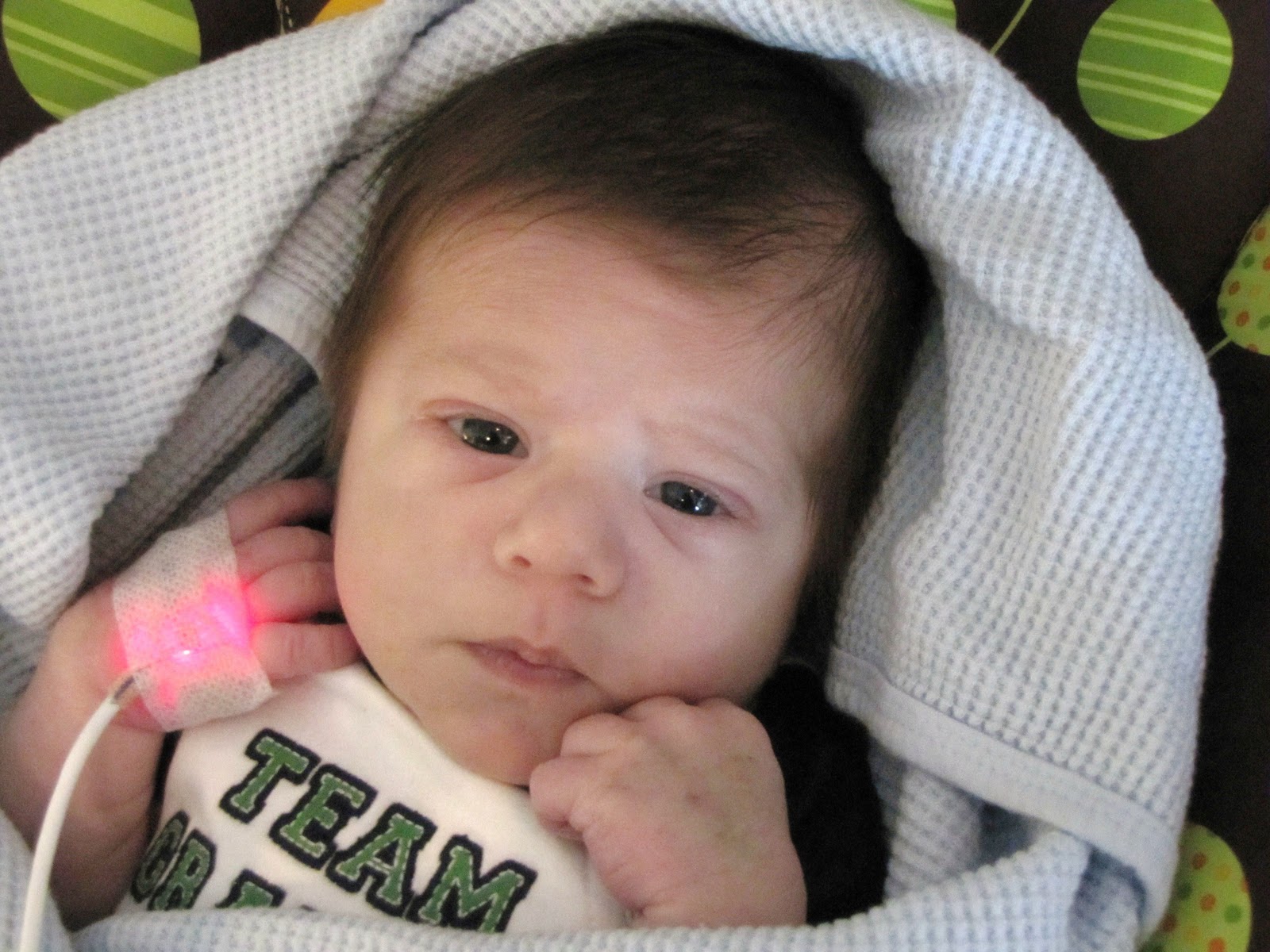
They discharged me a day early to be with Caleb the next day. We went home, got changed, and off we went to this hospital we knew nothing about. We went to the Shands’ neonatal intensive care unit and saw Caleb. It was terrifying. He was on a ventilator and had monitors everywhere. The beeps were too much. I wanted someone to tell me what was going on. I felt completely alone, although I wasn’t.
Caleb, while he waited for a heart.
Dr. Gonzalo Wallis met us in a conference room where he told us about Caleb’s diagnosis —several congenital heart defects that make up hypoplastic right heart syndrome (the right side of Caleb’s heart did not completely form during fetal development). Dr. Wallis assured me that nothing I did while pregnant caused this. I knew that in my heart, but I still couldn’t help but feel guilty. I remember Dr. Wallis and my uncle, a pediatric nurse, said I could be thankful Caleb didn’t have hypoplastic left heart syndrome, because that was so much more dangerous. “Finally,” I thought, “some good news.”
Caleb with one of his nurses.

We learned Caleb would need open-heart surgery in a couple of weeks. I felt awful for my child. He’s so tiny and no one that little should ever have to go through something that serious. I knew it had to be done, though, and as much as I hated it, I understood and gave consent.

On Jan. 7, 2010, before his surgery was to take place, Caleb had a heart catheterization (to make sure everything was just as it looked on his echocardiogram). I went down with them to take Caleb to the pediatric “cath” lab. Right before Caleb went back, he started to cry heavily, and he was swelling. His eyes were swollen and he turned even more purple. I kissed him through my tears and while they took him in, I turned to my family and broke down in tears. I knew he was sick and I couldn’t do a thing for him. It was unsettling.

The results came back from the heart cath: his coronary artery had sinusoids, or, as it was explained to me: pressurized blood vessels. Shands’ congenital heart surgeon Mark Bleiweis told me that if the first surgery was attempted, Caleb would have a heart attack and die. Our only other option was a heart transplant. I felt my world end right then and there. I knew nothing about transplants and to hear everything I was hearing was horrible.

After meeting with Caleb’s cardiologist and surgeon, I couldn’t take hearing anything else from anyone else, so I left alone and wandered the halls, crying. All the mundane worries I had before seemed so pointless now. All I wanted was Caleb to be healthy and home.

I remember listening to a nurse talk on the phone about buying a new house and how excited she was. It was hard to hear people’s lives going on, when my life was at a standstill. It was like every person around me was moving and I couldn’t move. I wasn’t able to, as much as I wanted to. It were as if someone were holding my hands behind my back and parading me in front of Caleb, telling me to help him, but I couldn’t. I was helpless in more ways than one.

I sat in the middle of the 3rd floor at Shands and cried harder than I think I have ever cried in my entire life. I didn’t care about all the stares I was getting. I didn’t care if I looked like a mess. My world was crumbling before me and I just wanted to curl into a ball and die.

The next three months were a blur. There were days when I had this overwhelming sense of confidence and strength, and I just knew I could do this. I would laugh with the nurses, with whom I had become close. I even looked forward to going to the 3rd floor.

Then there were days when I was in a dark place. I wanted to throw my hands up and say, “I’m done.” I would see parents come and go from the NICU with their babies in tow, or I would hear them cry out when they were told their baby had to stay four days for jaundice. I would get angry. I wanted them to know how much I would love it if jaundice were the only reason we were in the NICU.

I begged the nurses to move me away from everyone else because it was too hard. I was becoming angry and bitter. Toward the end of Caleb’s stay in the NICU, he took a turn for the worse. He couldn’t eat by mouth anymore. He was fed everything through a nasogastric feeding tube. He couldn’t tolerate his meds anymore. The tissues around his bones were inflamed. He was swollen all over. He didn’t look like my child. I couldn’t hold him. He would squirm and cry in pain when we changed his diaper.

Caleb, just after open-heart surgery.
The doctors met and decided they couldn’t wait anymore and they were going to go ahead with the “bidirectional Glenn,” which is the second stage of the three stages of surgeries (the first is the Norwood and the third is the Fontan).

Talking to Caleb after surgery.
They took Caleb back to the operating room on March 16, 2010. I couldn’t watch them wheel him away again; I stayed at the Ronald McDonald House. I didn’t want to tell him “goodbye.” It was too gut-wrenching. I wanted to remember him from the night before, when he actually had a good night. It was like he knew the next day, he was having the surgery and he would start feeling better.
 
The days after his surgery were tough. He was in a lot of pain. It had been so long since he had eaten by mouth, he forgot how to do it. He went through withdrawals from the pain meds, he got an infection at his incision, and he had a blood clot in his leg. It was a roller coaster. 

He stayed in the Shands’ pediatric intensive care unit for five weeks recovering from his open-heart surgery. He went home with a feeding tube. All of his meds and formula were to go in there. He started having violent episodes of vomiting. Seriously, it was like something out of The Exorcist. They determined he had gastroesophageal reflux, a severe type of acid reflux, and started him on meds for it.

During Caleb’s recovery, I watched a new baby emerge — one who smiled, giggled and cooed. I hadn’t really seen or heard that before. He was a quiet baby in the NICU. Now he was getting a personality and I loved every minute of it. My own personality started coming back. I noticed that once he started changing, so did I. My strength was back. My sense of humor was trying to come back. I felt more like me than I had in a long time.

While Caleb was in the NICU, I remember meeting Dr. Jay Fricker, chief of pediatric cardiology at Shands/University of Florida College of Medicine; he is now Caleb’s cardiologist. I thought he was very serious and needed to laugh more. Obviously, the NICU isn’t a place for laughter or joking, but I told myself that once I was out of there, I was going to make him laugh. It was my goal and my day would come.

On April 19, 2010, just three days before Caleb was 4 months old, he finally came home with us. It was a bittersweet moment. I was beyond elated to finally be a mom. I hadn’t felt like one yet because Caleb’s nurses did most everything I would have done if we were at home. At the same time, I was scared beyond belief. “What if something goes wrong”? I don’t have the comfort of a nurse right beside me.

The ride home was surreal. I think we drove 10 miles per hour under the speed limit. It was odd to see this tiny person next to me in the car and know all he had already been through, and now we were going home to try our hand at “normalcy.”

The first night was a rush I can never explain. It was amazing just to sit at home and watch TV with my husband and dogs, and with my child in my arms. I never thought that day would come. It filled my heart with the love I remembered feeling four months before when Caleb was born.

At our first appointment with Dr. Fricker after Caleb was discharged, I told him how much I hated how he, the nurses — pretty much everyone — called me “Mom,” instead of by my name. My name is not Mom. I understand they have so many patients and families that it’s impossible to remember everyone’s name, but I feel like the only person who’s allowed to call me Mom are my kids, and these doctors and nurses are absolutely not my kids!

Now it’s a running joke between Dr. Fricker and me. We saw each other at a conference recently, where we both wearing nametags. Caleb had an appointment the following week and I told Dr. Fricker I was wearing my nametag so he would be sure to call me “Kim.” He laughed! It was one of many times since Caleb has left the hospital that I’ve made Dr. Fricker laugh. He’s done well calling me Kim, with only a few slip-ups here and there, which I have forgiven.

Something I remember Dr. Fricker telling me is that I have one of the best personalities of any of the parents he’s met. He said I always have a smile on my face. That hasn’t always been the case, but watching Caleb thrive and knowing how he has changed my life has completely changed my outlook on life. I don’t worry nearly as much as I used to about the trivial things.

Caleb, today. A funny, smiling, beautiful little boy.
I still worry about Caleb’s health, but I try to live every day for today and not tomorrow. I think back on everything we went through, and if I were given the opportunity to do it all again, knowing what I know now, I would do it all again without changing a thing.

My “heart baby” has given me a new purpose to life and a new joy I never expected. I’ve met amazing heart families and doctors who have given me hope and strength, as well as lifelong friendships that mean the world to me.

Right now, Caleb is in his crib babbling away and saying “mamamamama.” It just feels right hearing that from my little miracle. Nothing can compete with that. He is doing amazing! He’s walking, talking and eating like a champ (the feeding tube was taken out in November 2010).

We have another surgery soon (the Fontan procedure) and possibly, one day, even a heart transplant. But I know now, I can handle this, and more importantly, so can Caleb. This “mom” thanks the wonderful people at Shands who did, and continue to, go above and beyond for us We have an amazing team and support system around us that really makes a world of difference.  Thank you for giving me Caleb back to me.

Friday, July 22, 2011

Have You Loved Your Scar Today?

Broken Hearts of Florida is thrilled to partner with Rock Scar Love and Amy Tippins! 

An amazing woman with a big scar and a bigger heart, Amy and her RockScar Love inspire passionate lives through clothing. RSL celebrates sexy scars, the lessons they teach us and the strength they create.

When you shop from the Broken Hearts of Florida affiliate page, RSL donates 10 percent of the proceeds to Broken Hearts. We, in turn, use funding to support Broken Hearts programs and services,  such as our monthly potluck dinners for family and friends, nonperishable food for our Food from the Heart Pantry at the Shands Children's Hospital's pediatric intensive care unit, our annual May Day Picnic, and our Regional Forum on Congenital Heart Disease.

Help us help our families! Buy stuff! Plus, Amy's designs are so cool! Read more about Rock Scar Love and Amy Tippins. Then, GO SHOPPING!


Monday, November 8, 2010

A Baby. Really? But I’m Almost 43!

By Penny Putman

Penny with her youngest son, Wyatt.
Only God knew the amazing journey He had planned for us when we found out we were going to have a baby in the fall of 2008. I was almost 43; we just knew I was entering menopause. But God had a much better and bigger plan than we could have imagined. Our lives were about to change forever.

At the time, we had Ethan, 16, and Forrest, 8, and life was pretty easy. A baby. Really? What was God thinking? After adjusting to the shock of the pregnancy, we knew our risks for having a baby with Down syndrome were higher because of my age. We chose to not have prenatal testing because we knew it did not matter if our baby had Down syndrome; he was God’s plan from the start, and we knew God was in complete control.

After a very quick delivery, Wyatt Christian Zane Putman was born July 6, 2009. He was a beautiful, healthy baby! We were told a few days after he was born that he has Down syndrome. We were devastated. I will never forget the pain of those first few days.

And there was more to come. At his first check up when he was 5 days old, the doctor detected a heart murmur. We were told of the high percentage of babies with Down syndrome who are born with congenital heart defects. “Wasn’t the Down syndrome enough?,” I wondered, “Does he (we) have to have more to deal with?”

At 10 days old, Wyatt had an echocardiogram, performed locally by a pediatrician who had cardiac training. Wyatt was diagnosed with a small ventricular septal defect, a small hole between the ventricles, and a small atrial septal defect, a hole between the atria. We were told they likely would close on their own without needing surgery.

As we looked for support locally concerning Wyatt’s Down syndrome, we were told over and again the local doctor often missed important diagnoses, and that it was imperative we seek the opinion of a pediatric cardiologist.  

Wyatt, shortly after surgery.
We traveled to Pensacola for an appointment with Dr. Joseph Davenport at the Nemours Children’s Clinic. We knew we were at the right place. His awesome staff, thorough examination and diagnostic testing, confirmed the original diagnosis of ASD and VSD, but with the decision to closely monitor the holes to be sure they closed. We had appointments every couple of months until January 2010, when Dr. Davenport decided it was time to send Wyatt’s records to Children’s Healthcare of Atlanta at Eggleston for surgeons to evaluate. Within a couple of weeks, we heard back from Eggleston –  they believed it was necessary to operate. We were devastated and scared. And I asked, again, couldn’t his Down syndrome be enough for us to deal with? 
 
A happy Wyatt healing after surgery.
As much as everyone reassured us he would be fine, it wasn’t their child having his chest opened up for surgery. Praise God, Wyatt’s surgery went smoothly, taking less than two hours. We were quickly able to see him in recovery. He actually looked much better than I had prepared myself for. Wyatt spent about 48 hours in the CICU before being transferred to the step-down unit where we spent another 48 hours before being sent home. WOW! That was scary, leaving Atlanta to head home to Panama City with our baby boy who had just had open heart surgery!

Within just a few days, he was back to his happy self. Wyatt never indicated he was in any pain, and he healed quickly. By four weeks post-op, he was allowed to resume his physical therapy. His prognosis is good, and his cardiologist visits are farther and farther apart. He is now a 16-month-old, busy, little boy!

We were amazed at how quickly God healed our baby! Throughout his surgery and recovery, Wyatt was bathed in prayer by hundreds of people around the world, and we are so thankful for the answered prayers.

We know that God has great plans for Wyatt: “ ‘For I know the plans I have for you,’ declares the Lord, ‘plans to prosper you and not to harm you, plans to give you a hope and a future.’” (Jeremiah 29:11 NIV) We give God all the glory for Wyatt’s fixed heart!

Penny Putman is wife to Tim and stay-at -home mom to three awesome sons; a terrific teen, Ethan, a cool kid, Forrest and an adorable baby, Wyatt, who just happens to have a little something extra, Down syndrome. Wyatt’s birth 15 months ago dramatically changed the Putmans’ lives. Penny’s  life now revolves around therapies, doctors’ appointments and online research about Down syndrome, in addition to everyday household stuff and her responsibilities as women’s ministry team leader for her church. Wyatt has physical, occupational, speech and developmental therapies every week. Fortunately, they come to the Putmans. In addition to Wyatt’s heart issues, Penny also is currently working on hearing and thyroid questions. It’s a busy life, Penny says, one she could never handle except by God’s grace, and her relationship with Jesus as her personal Savior! Follow the Putmans' life at www.pennyspeeps.blogspot.com.

Monday, June 14, 2010

What I Know for Sure

Alyssa and I have known each other since 2002, long before we had our second babies -- our heart babies. In June 2006, when my son had open-heart surgery, Alyssa organized meals, collected baskets of goodies, and took care of our house and critters while we were gone. Her support, as well as support she rallied from others, got us through. She did it for no other reason than she cared. She had no way of knowing that 2-1/2 years later, she would face a similar crisis. When Alyssa learned her unborn daughter had complex CHD, Broken Hearts of the Big Bend rallied for her. For no other reasons than because we cared and we understood.

What I Know for Sure


On Aug. 21, 2008, when I was five months pregnant, during what we believed to be a simple follow-up ultrasound, my husband Shevie and I learned that our unborn daughter had multiple complex congenital heart defects (CHD). Devastated does not begin to describe how we felt.

When you learn something is wrong with your unborn baby’s heart – her heart – it is hard not to think the worst. It’s even harder to imagine you somehow will emerge from the harrowing experience you now know is ahead of you better than you were when you entered it. When you don’t know the direction of the tunnel you are in, or where its end is, is it really possible to see the light?

For me, it was impossible to see the light during that critical time, but it was impossible for me not to believe in it. After all, since 2006, I had been a volunteer with Broken Hearts of the Big Bend. I worked with Karen Thurston Chavez when she started the group in June 2006, the same month her son, William, had open-heart surgery at Shands Children’s Hospital.

I had no idea at that time the work Karen was doing to educate and unite families in the Big Bend area who were faced with CHD would be so relevant to me. I had no idea when I was volunteering, I was helping to make a better life for a baby I then had no idea I was going to have.

What I do remember is wondering how the parents in the group managed to be so brave. I remember looking at the kids and thinking many of them looked so healthy that if I didn’t know they had heart defects, I wouldn’t have suspected it at all.

What I learned from Karen and others in the group through volunteering and just talking to them prevented Shevie and me from having to blindly navigate our way through Tallahassee’s medical community, which, for the record, does not include a board-certified pediatric cardiologist. We knew that to give McKenna the best chance at not only a good outcome but mere survival, she needed to be born at Shands at the University of Florida under the care of its Congenital Heart Center’s pediatric cardiologists.

To make this happen, Shevie and I traveled back and forth to Gainesville multiple times after the fateful ultrasound. Two weeks before my due date, we left home and checked into a hotel in Gainesville. Leaving Victoria in Tallahassee with her father (my ex-husband), and his family was hard because I did not know when I would be able to come home to her. I was thankful, though, that she got to stay with family and I wondered what other families, who didn’t have anywhere to leave their other children, did in such circumstances.

While in Gainesville, we spent 15 days walking the mall and other places trying to get my labor going, but were unsuccessful. On Nov. 25, we went in for an induction. McKenna was born the next morning at a healthy 7 lbs. 1 oz. After her birth, doctors confirmed she had double-outlet right ventricle, hypoplastic left ventricle (not full-blown hypoplastic left heart syndrome) and atrial and ventricular septal defects. We were so relieved because that was so much better than her original diagnoses of hypoplastic left heart syndrome, double-outlet right ventricle, transposition of the great arteries and atrial and ventricular septal defects. The plan for McKenna’s CHDs included the three-stage repair – the Blalock-Taussig Shunt, the bi-directional Glenn and the Fontan. She did so well after birth, she did not need the BT shunt, but did require a heart catheterization to widen her ASD to help her heart work more efficiently. She had her Glenn done in March 2009 and will have her Fontan in the next year or two.

The next five months were simultaneously sweet and filled with anxiety. In addition to the typical trials of having a new baby – sleep deprivation being the hardest to tolerate – we had numerous, constant doctors’ visits and an emergency hospital stay. When we were lucky enough to be at home, I feared that anything – too much crying or excitement – could be harmful to McKenna.

I wish I could say I endured these struggles with grace. Truth is, I spent so much time and energy trying to do everything I could to keep McKenna well and to not neglect Victoria in all the chaos, I spent what little time I had remaining praying, crying or cursing, depending on the circumstances.

I’ve had some pretty dark times in my life, but none as dark and complex as this. On one hand, I had a beautiful, new baby girl and relished watching her thrive. Yet on the other, I spent every moment in conflict, afraid I would lose her and unsure how I would go on if I did.

Those who know me well, know that above all things, I treasure feeling secure. In retrospect, I realize the intense conflict and despair I felt during those dark times were the beginnings of my coming full circle and learning to accept what felt like a hard, bitter truth: anything can happen to any one of us at any time. We really only imagine we have any security at all. Though accepting this truth blows a hole in the adage, “ignorance is bliss,” it truly gives new meaning to understanding the light at the end of the tunnel, and making a conscious choice every day to live in it.

And so now, just after the 18-month-mark, as I find myself sitting here, writing about it all, I know for sure I am a changed woman. In some ways, I’ve changed for the better: I usually take pleasure in activities that used to feel like drudgery: driving home, tackling tough homework assignments with Victoria, cooking. I know my worst day at work is better than the best day when my baby was in the hospital.

In others, I’ve changed for the worse: My temper is horrible. It has been all along, but I’ve lost the ability to control it when I most need to. I also probably border on obsessive-compulsive disorder when it comes to worrying about germs. I think about having enough Lysol® wipes and hand sanitizer in the house more than I think about having enough food. Sad, but true.

McKenna is thriving. She loves to eat and weighs a healthy 22 lbs. She takes medicine three times a day and we go to Shands for check-ups once every few months. Victoria is an awesome big sister. We know McKenna needs one more surgery, the Fontan, but we’ve had a lot longer to prepare for it than we did the first one and we are not doing so under duress. Shevie and I have both been fortunate enough to keep our jobs and have excellent insurance. I think very often about parents we met at Shands who were losing their jobs or being evicted from their homes while they sat by their child’s bedside. When I think of them, I know our trials are hardly the worst or most heartbreaking.

My mind often wanders back to the days, the years, before McKenna was conceived or even thought of. The days when I was just a volunteer, asking myself how the parents in Broken Hearts of the Big Bend managed to be so brave when their children’s hearts weren’t anatomically perfect. Now that I’m one of them, I can answer the question.

My answer is…I don’t know. In the thick of it, it didn’t feel like bravery, it only felt like doing what I had to do to save my daughter’s life. If it happened to you, you also would have done the only things you could: prayed to God, trusted your doctors and loved your baby.

Here’s what I know: In the end, it all has been worth it, and my new normal is pretty sweet. McKenna is beginning to use words now and I’m sure, if she knew how, she’d tell you the same.